By Naveed Qazi
In a high-stakes push to turn toxic agricultural smoke into sovereign fuel, India is rapidly scaling a nationwide network of compressed biogas plants aimed at breaking its reliance on expensive gas imports. Backed by a newly sanctioned ₹23,731 crore government scheme and an expanding grid of over 200 operational facilities, New Delhi is betting that transforming millions of tonnes of rotting crop residue into transport-grade biomethane can simultaneously clean northern skies, cut fuel import bills, and jump-start a circular rural economy.
Scaling India’s Compressed Biogas Network: The SATAT Expansion and GOBARdhan Scheme
India’s clean energy transition is witnessing a structural shift by treating organic biomass as an economic driver rather than a disposal crisis. As of August 2026, 1,929 CBG and Bio-CNG plants have been registered nationwide, comprising 217 commissioned plants and 357 currently under active construction. This marks rapid progress from March 2025, when the country had 150 commissioned projects yielding a cumulative output of 1,211 tonnes per day.
To dramatically accelerate production, the Union Cabinet approved the ₹23,731 crore GOBARdhan National Circular Bioenergy Scheme in August 2026, running through 2035–36 with the target of expanding domestic CBG generation nearly ten-fold. Decentralised CBG production offers a direct path to reducing reliance on imported natural gas while generating vital rural employment and reinforcing domestic energy security.
 Clearing the Skies: Turning Stubble Burning into Farm Income and Biofertilisers
A central environmental driver for the biogas push is mitigating seasonal crop residue burning across northern India, a persistent contributor to hazardous air quality and greenhouse gas emissions. Converting agricultural waste into transport-grade compressed biogas transforms an acute ecological liability into a valuable commercial commodity.
The circular model delivers direct agronomic gains. Alongside clean fuel, the anaerobic digestion process yields organic digestate as a commercially viable by-product. This organic fertiliser enriches soil health and reduces agricultural reliance on chemical fertilisers. By integrating clean transport fuels with rural development, compressed biogas simultaneously reduces transport-sector emissions and stimulates economic activity in farming communities.
Supply Chain Logjams and Financing: The Hurdles Facing CBG Developers
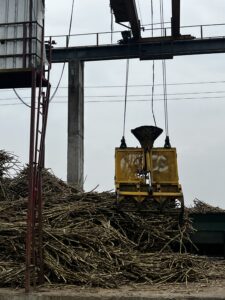
Despite the issuance of hundreds of commercial Letters of Intent, the pace of operational plant commissioning has encountered significant structural friction. Feedstock logistics remain the primary bottleneck: because crop residues are scattered across millions of smallholder farms, their low bulk density makes collection, handling, and year-round transport expensive.
Project financing poses an equally steep hurdle. While public sector oil marketing companies provide long-term purchase assurances, developers—especially rural entrepreneurs—face high upfront capital costs, persistent financial uncertainty, and constrained access to affordable credit. Furthermore, anaerobic digestion demands rigorous biological process management and consistent feedstock quality; historically, an emphasis on build-out targets over long-term operational efficiency has left several facilities underutilised. Fragmented governance across multiple government ministries adds further regulatory complexity.
 Global Benchmarks and Policy Roadmaps: Powering India’s Circular Bioeconomy
International precedents highlight practical blueprints for unlocking the full potential of biomethane. Germany and Italy have built thriving sectors by coupling stable feed-in tariffs with direct injection into the gas grid and heavy transport integration. Sweden powers municipal buses and waste collection fleets using biogas derived from food waste and sewage sludge, while Brazil reduces collection costs by pairing sugarcane bagasse and livestock waste with its existing ethanol infrastructure. Even Estonia shows how predictable regulations and strict quality standards foster industry growth despite limited raw biomass.
To replicate this stability, policy experts recommend organising biomass collection through Farmer Producer Organisations (FPOs), agricultural cooperatives, and decentralised aggregation centres. On the financial side, introducing concessional lending, blended public-private finance, and risk-sharing mechanisms is vital to attract mid-sized investors. Alongside technical training for plant operators and engineers, diversifying biomethane consumption into city gas distribution networks and industrial heating will provide the demand resilience needed for sustainable commercial viability.
 Naveed Qazi is an author and serves as Editor at Large for Science Matters. Hailing from Srinagar, Kashmir, with a postgraduate degree in International Business from the University of Hertfordshire, UK, he writes on science, technology, business, and global affairs, and has contributed to leading English-language newspapers in Kashmir.