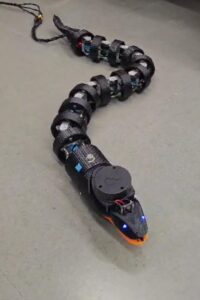
A team of researchers at Lovely Professional University (LPU) has engineered a bio-inspired serpentine robot designed to navigate collapsed buildings and hazardous industrial sites.
By mimicking the flexible locomotion of a snake, the robot can access high-risk, confined environments that are unreachable for humans or traditional wheeled machinery.
The project, developed by engineering students Tummala Pradeep, Sushakar Kakumani, Batala Muniratnam, Marri Kruthik, and Katam Nani, was supervised by Dr. Raam Dheep from the Department of Robotics and Automation.
Revolutionary Design for Search and Rescue
The primary focus of the innovation is to provide a life-saving tool for disaster response, specifically in the aftermath of earthquakes or fires. Unlike conventional robots, this serpentine model excels at traversing uneven debris and narrow gaps.
“The proposed project focuses on the development of a serpentine rescue robot for disaster management in earthquake-affected buildings,” Dr. Dheep, Assistant Professor at LPU, explains the critical need for this technology.
“Inspired by the flexible locomotion of snakes, the robot is designed to navigate through narrow gaps, collapsed structures, and uneven debris where conventional wheeled robots cannot operate effectively,” Dheep told Science Matters.
Advanced AI and Sensor Integration
To ensure the robot can perform effectively in “blind” or dangerous zones, it is equipped with high-tech sensor fusion and AI-based adaptive control. These features allow the machine to assess environmental hazards and locate survivors autonomously.
According to Dr. Dheep, the robot acts as a mobile sensory hub: “The system can be integrated with sensors such as thermal cameras, gas sensors, microphones, and obstacle detection modules to identify trapped victims and assess hazardous conditions in real time.
“By incorporating autonomous navigation and adaptive movement control, the serpentine robot aims to enhance search-and-rescue operations, reduce risks to human rescuers, and improve response efficiency during natural disasters”.
Industrial Maintenance and Infrastructure Monitoring
Beyond emergency response, the robot has significant applications in the industrial sector. Its modular design makes it ideal for:
- Pipeline inspections in oil and gas sectors.
- Hazardous environment monitoring where human presence is unsafe.
- Infrastructure maintenance in complex urban or underground systems.
National Recognition and Patent Filing
The LPU team said its innovation has been met with significant acclaim, most notably at ROBOFEST-GUJARAT 5.0, organised by the Gujarat Council on Science and Technology. The team says it has secured ₹50,000 during the ideation phase and an additional ₹2,00,000 for the successful prototype phase.
Highlighting the project’s technical originality, LPU and the student team have officially filed a patent for the robot (Application No. 202521120184).