A path-breaking study from North East India has identified a critical link between the biological “type” of breast cancer and how successful surgeons are at removing it entirely. The research, published in the prestigious global journal Discover Oncology (Springer Nature), provides vital insights into why some tumours are more likely to leave dangerous cells behind after surgery.
The Key Discovery: A Matter of Margins
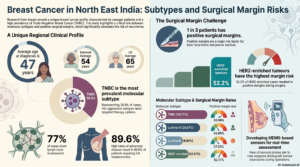
The most significant finding for patients is that women with the HER2-enriched subtype are at the highest risk of “positive margins”—meaning cancer cells are unintentionally left at the edges of the surgical site. In this study, over 52% of HER2-enriched cases resulted in positive margins.
In a surprising twist, while Triple Negative Breast Cancer (TNBC) is the most common and aggressive subtype in Assam, it actually showed the lowest rate of positive margins, making it easier for surgeons to remove cleanly.

The Expert Perspective
Lead researcher Dr. Gayatri Gogoi, Professor of Pathology at Assam Medical College (AMC) and Adjunct Faculty at ICMR-RMRC, explains that the difficulty lies in how a tumor feels to a surgeon.
“The aggressive HER2-enriched subtype may retain physicochemical properties closer to normal tissue, making precise boundary assessment more difficult,” the research team notes.
They hypothesize that different cancer types produce varying degrees of “stiffness, pressure, or optical density,” which affects how doctors differentiate between a tumor and healthy tissue by touch.
Why This Matters
When a surgery results in positive margins, the consequences are severe:
- The risk of the cancer returning in the same spot doubles.
- It is linked to shorter survival and higher rates of the cancer spreading.
- “A positive tumor margin remains a major risk factor, placing nearly one in three women at risk of local recurrence,” says the study.
The Assam Context: A Younger Struggle
The study highlights that breast cancer in Assam hits much younger than in the West. The average age of patients was just 47 years old (compared to 65 in the US), with nearly 69% of cases occurring in women under 50. Furthermore, 77% of patients were only diagnosed after the cancer had already spread to their lymph nodes.
Methodology & Institutions
This cross-sectional study analyzed 155 cases of invasive breast cancer at a tertiary care centre in Upper Assam between 2019 and 2025. The team, which included experts from Assam Medical College, Tinsukia Medical College, and the Indian Institute of Science (IISc), Bangalore, used immunohistochemistry (IHC) to categorize the cancers and microscopic examination to check the surgical edges.
The Future: Real-Time Solutions
To solve this problem, Dr. Gogoi’s team is working with Hardik Jeetendra Pandya from IISc Bangalore to develop high-tech tools. They are creating a “multimodal, fabricated MEMS-based electrical sensor” and a specialized ultrasound probe to help surgeons identify cancer boundaries in real-time during an operation.
Study Limitations
While the findings are significant, the researchers note that this was a cross-sectional study, meaning it captured data at a single point in time. There is currently no long-term follow-up data on how these specific margins affected the 5-year survival rates of the participants, though Dr. Gogoi’s team is actively working to collect this information for future reports.