What began as a simple observation by an educator standing in front of a classroom has evolved into a breakthrough in artificial intelligence that could redefine how we measure human attention.
A research team led by Dr. Dhatri Mehul Pandya, Dr. Keyur Mahesh Rana, Devanshu Govind Mangal, and Dhairya Prajapati at Department of Computer Engineering, Sarvajanik College of Engineering & Technology, Sarvajanik University, Gujarat, has secured a patent for a system that scientifically measures cognitive engagement in real time while strictly upholding personal privacy.
The innovation, titled “System and Method for Real-Time Cognitive Engagement Assessment Using Embedded Artificial Intelligence and Visual Behavioral Indicators” (Publication No.: IN202621044745 A1), represents a significant shift from invasive monitoring to ethical, data-driven insights.
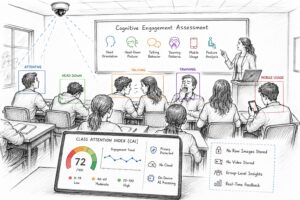 Bridging Psychology and AI: The Evolution of Classroom Observation
The core challenge addressed by the team was moving beyond subjective “gut feelings” about student focus to an objective, scientific measurement. By merging educational psychology with computer vision, the researchers identified specific, non-intrusive behavioral indicators that signal a person’s mental state.
The system tracks five key behaviors: head-down postures, off-task talking, yawning patterns (as a sign of fatigue), mobile device usage, and general posture analysis. These metrics are then processed through a psychology-informed weighted behavioral model, where different actions contribute to a final, nuanced Cognitive Engagement Score.
Privacy by Design: Why This AI Never Stores an Image
Unlike existing solutions that often rely on cloud storage or continuous video recording—raising significant security and surveillance concerns—this new architecture is built on “privacy-preserving” principles.
The breakthrough lies in its use of embedded edge devices. All AI processing occurs locally on the hardware itself; raw images and videos are analyzed and then discarded immediately after inference. This ensures that no personal visual data is ever stored or transmitted to external servers, effectively allowing the AI to “observe” behavioral patterns without ever “identifying” the individuals involved.
 Measuring Collective Focus: The Rise of the Group Cognitive Engagement Index
The technology moves away from individual tracking to focus on the “room” as a whole. It computes a Group Cognitive Engagement Index (GCEI), which represents the collective attention level of an entire group. This approach provides actionable intelligence for speakers and organizations without the ethical baggage of monitoring specific persons.
While the project started in a classroom, the research team highlights a vast array of potential applications beyond education. These include:
- Corporate Training: Evaluating the effectiveness of professional development.
- Industrial Safety: Monitoring for fatigue or distraction in high-risk environments.
- Driver Attention: Enhancing road safety through real-time alertness assessment.
- Healthcare: Assisting in rehabilitation and behavioral research programs.
As the researchers noted, this journey illustrates how impactful innovation often begins with a simple question about human behavior, eventually evolving into a tool that balances technological capability with the fundamental right to privacy.