By Naveed Qazi
In the snow-bound reaches of the Gurez Valley, a quiet revolution is unfolding as traditional Himalayan “superfoods” and high-tech farming converge to redefine Kashmir’s economic landscape. Long isolated by harsh five-month winters and limited growing seasons, the region is now spearheading a transition from subsistence farming to a diversified, technology-driven economy through the revival of climate-resilient buckwheat and the implementation of the massive Holistic Agriculture Development Programme (HADP).
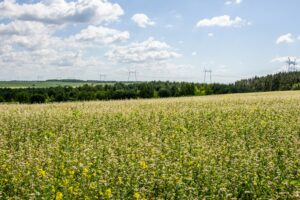
Gurez Valley in north Kashmir has long been defined by its geographical isolation. The region has a short growing season as prolonged winter snowfall of nearly five months each year restricts agricultural activity. Yet these constraints have made Gurez Valley potentially suitable for cultivating buckwheat, a traditional Himalayan pseudo-cereal valued for its short maturity period, nutritional richness and a high tolerance to marginal growing conditions. While historically a staple heritage food in Gurez, buckwheat cultivation plummeted over the last few decades amid changes in food consumption, and growing availability of subsidised rice and wheat.
The Buckwheat Revival: A Climate-Resilient Superfood for Kashmir
In one of the most widely cited reviews of buckwheat improvement, Campbell (1997), writing in International Plant Genetic Resources Institute (IPGRI), described buckwheat as a short duration crop well adapted to marginal mountain environments. The scholar emphasised its considerable potential for genetic improvement and wider cultivation because of its modest cultivation requirements. More recently, Gimenez-Bastida and Zielinski (2015), writing in Journal of Agricultural and Food Chemistry, highlighted buckwheat’s exceptional nutritional profile, including high-quality proteins, dietary fibre, rutin and other bioactive compounds that have increased its appeal among health-conscious consumers around the world.
In Nepal and Bhutan, for example, there is a strong cultural and dietary presence of the crop, and its demand among Indian consumers is also increasing in northern and northeastern states. In international health-food markets, the crop is marketed as gluten free, having likely positive effects on cardiovascular health and glucose metabolism. It also supports high value beekeeping (buckwheat honey) which produces high nectar yields that can actively support local apiary setups, giving mountain farmers an opportunity for a diversified dual income.
That is why buckwheat is re-emerging as part of Kashmir valley’s climate resilient agriculture, as scientific evidence supports this shift for better potential. Strengthening the narrative, a comprehensive review in Frontiers in Sustainable Food Systems further argues that buckwheat’s resilience to moisture stress make it an increasingly valuable crop for sustainable food systems.
Local research at SKUAST-K further highlight buckwheat’s strategic importance. In a study published in Plant Genetic Resources, Bhat et al.(2023) examined sixty-one different buckwheat samples representing common and Tartary buckwheat in the context of the Northwest Indian Himalayas.
They identified considerable diversity and genetic variation in characteristics of the crop for future breeding and conservation efforts.Hence, according to local scholars, conserving buckwheat in Kashmir Valley will likely not only preserve cultural heritage but also safeguard a genetic resource pool for future Himalayan agriculture, improved agriculture outcomes and commercial applications.
HADP and Technology: Transforming Subsistence Farming into a Specialised Seed Hub
Recognising the potential to scale, the Government of Jammu and Kashmir’s Holistic Agriculture Development Programme (HADP) promotes a transition from subsistence farming to diversified, technology-driven, agricultural economy through quality seed production, protected cultivation, farm mechanisation, digital extension and integrated value chains.
The programme has facilitated more than 1.11 lakh agricultural units, including high-tech polyhouses, advanced machinery banks and vermicompost structures. Daksh Kisan Learning Management System also aims to expand digital advisory services, including online courses for capacity building of farmers across the region.
Through several research initiatives at SKUAST-K, Kashmir Valley is being developed as a specialised seed production hub, with official plans projecting potato seed production to increase from approximately 3000 quintals in the first year to around 30,000 quintals in the second year, alongside Kishan Ganga (KG-2) maize seed multiplication, extra early maturing wheat varieties called Shalimar Wheat (SW3) and (SW4) to strengthen local seed systems.
By encouraging farmers to participate in certified seed production, the programme seeks to generate higher value rural enterprises while reducing Jammu and Kashmir’s dependence on imported seed, but there is significant scope for expansion and improved utilisation to meet targets. Factually, HADP’s ambitions extend beyond buckwheat, potato and wheat cultivation. The programme spans nineteen integrated projects for crop and horticulture including mushrooms, bee keeping, vegetables, medicinal plants, saffron, floriculture and other niche crops suited for distinct agro-climatic zones. Three projects are reserved for production and infrastructure excluding livestock and R&D.
From Farm to Global Markets: Value Addition and GI Branding
Diversification alone will not guarantee rural prosperity unless and until it is accompanied by value addition and stronger market integration. HADP aims to tackle this by various project solutions. Buckwheat, mushrooms, high-altitude honey and high-altitude vegetables will continue to generate limited returns as long as they are marketed as raw commodities. Establishing number of local milling factories for buckwheat flour, mushrooms processing units, honey packaging units and small-scale food enterprises would help farmers to retain a greater share of value created along the supply chain.
Organic certifications, geographical indication (GI) registrations and highly professional branded products could strengthen the competitiveness of Gurez’s agricultural products in premium domestic and international markets. The successful commercialisation of products such as Bhaderwah Rajmash already demonstrates how place-based branding, when supported by quality assurance, processing infrastructure, and effective marketing can substantially enhance rural incomes.
Similar opportunities may exist for other niche Himalayan crops if supported by long term procurement contracts, stable, long term supply chains, producer organisations, and public-private partnerships in seed production and food processing. What also matters in this change is that technological transformation cannot be achieved through individual ownership alone, particularly in remote tribal regions, where there are fragmented land holdings and limited financial resources.
Bridging the Implementation Gap: Overcoming Logistical and Financial Barriers
Despite these promising implementations, significant structural constraints remain. Geographic isolation continues to undermine agricultural competitiveness through high transport costs, seasoned road closures, and inadequate storage infrastructure. Several reports indicate that geographically remote districts including Gurez, Poonch, Rajouri, Reasi and Ramban continue to face logistical and institutional constraints that can affect programme implementation. The International Centre for Mountain Development (ICIMOD) has consistently identified market access, transport connectivity and climate adaptation among the principal challenges confronting mountain communities across the Himalaya.
HADP’s digital initiatives, including Kisan Sathi platform, aims to simplify registration, give grievance solutions, integrate farmer business tools and track farm outputs. However, access to institutional finance represents another persistent challenge and problems often arise in credit gaps, complex collateral requirements, delay in banking sanctions, and last-mile banking access for smallholders, even if HADP offers back-end subsidies. As HADP Vision Document (2022) acknowledges, balanced regional development and comprehensive interventions are fundamental to achieve sustainable agricultural growth throughout the region. It can only be achieved through better policy implementation and effective management in ground level execution and inter department co-ordination.

About the Author: Naveed Qazi is a prolific author and serves as Editor at Large for Science Matters India. Hailing from Srinagar, Kashmir, with a postgraduate degree in International Business from the University of Hertfordshire, United Kingdom, he writes on science, technology, business, global affairs, and has contributed to all leading English-language newspapers in Kashmir.