By Shakoor Rather
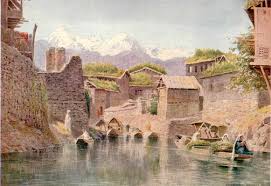
A wooden boat glides through placid waters against a setting sun as fishermen row close to waterfront houses with gardens that burst with colours.
It’s an idyllic picture of a Srinagar that once was, a visual recall of a waterway punctuated by arched bridges that was not just a navigational lifeline for the city but also a protection from heavy rains and floods.
The Nallah Maar (Maar is the Kashmiri word for snake), called so because it snaked through the city, is no more.
In its stead is a wide road that runs through Old Srinagar, providing connectivity but choking other waterbodies linked to it and blocking drainage avenues.
It is a story of heritage lost to urbanisation, neglect and environmental apathy, said old-timers and scholars.
The road paved the canal, some said, because it hadbecome a garbage dump. Others saw it as a political move.
Nallah Maar is believed to have existed from ancient times, but it was 14th-century King Shams-ud-Din Shah Mir who demarcated it as a distinct canal, Kashmiri poet Zareef Ahmad Zareef said.
“If the Jhelum was Srinagar city’s heart, Nallah Maar wasits soul,” he said.
When snow melted with the advent of spring, a huge volume of water would come down from the mountains, Zareef added.
The canal protected old Srinagar even during a major flood in 1903 when the upper town, including Amira Kadal, got inundated, historian Mohammad Yousuf Taing said.
It was an important business centre and a mode of inlandwater transportation. Goods and vegetables grown in the DalLake would be transported through it to people’s doorsteps.
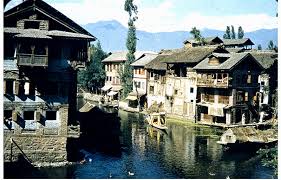
Archival images of the canal show crystal clear waters bordered by old Persian-style houses with flowerbeds, he said.
“There were houses on both sides of the canal. It wasflanked by ghats. Women folk would wash, bathe and clean household items on these ghats. It was because of Nallah Maarthat Srinagar got the title of ‘Venice of the East’,” he said.
Nallah Maar, with its network of branches, started from Brari Nambal lagoon in the old city. It had two diversions,one emptying into Anchar lake and the other into the Jhelum.
“It was more than a mode of transportation. It was ameans of connecting both social and religious life inSrinagar,” said sculptor and academician Rajender Tiku.
Over time, its once clear waters turned turbid because of a lack of maintenance and people dumping garbage into it.
“During Ghulam Mohammed Sadiq’s regime (in the 1960s) the canal was left to stink. In 1975, it was filled up during the reign of Sheikh Abdullah and turned into a road,” said Taing.
Srinagar’s identity has disappeared without the Nallah Maar, and it is now a city like many others, rued Saleem Beg, chairman of the government’s National Monument Authority and convener of Jammu and Kashmir’s INTACH chapter.
“If it is still possible to navigate through canals andwaterways in Venice, why can’t we do it here,” he asked.
In addition to its economic and aesthetic importance, Nallah Maar had religious significance, too.
“Muslims used to go to Qamar Sahab in Ganderbal andPandits to Kheer Bhawani in Tulmula by travelling in woodenboats through the canal,” said Tiku.
According to Zareef, the filling of the Nallah Maar alsohad a “political angle”.
People who lived by the canal were seen as supporters of the then Mirwaiz, he said, and when the road came up, theywere forced to relocate.
“…the canal was also partly filled to disperse thefollowers of the then Mirwaiz, who used to protest against thepolicies of Sheikh Abdullah,” Zareef added.
Beg stressed that the road did not serve any purpose.
“It was counterproductive to the drainage of the city. The main protagonists in the crime are the residents who lived around the canal,” he said.
“You lost a waterway which provided an aesthetic look tothe landscape, and water transport was an environmentally friendly transport which could save the city from pollution,” he added.
Tiku labelled the move an aesthetic disaster and said itleft the city prone to floods every time there was heavy rain.
He said he was caught in the 2014 floods that left largeparts of Srinagar underwater and killed more than 200 people.
“The way things are right now, if you take the example ofother canals and the lakes, including the Dal and the Wular, they are going the way Nallah Maar went. I believe we willonly be able to tell stories of these wonders to thegenerations to come, and that would be unfortunate,” he said.
But the experts said a revival was possible.
“We have the technology now. It has happened the worldover, including in South Korea. But the impediments are manybecause we have now found comfort in a changed landscape,” said Beg.