Imagine a global superpower where 90% of the cities, power grids, and transit systems required for its future do not yet exist. This is the “generational opportunity” currently facing India as it climbs toward a projected $30 trillion economy by 2047. Rather than merely retrofitting an old, carbon-heavy system, India is standing at a unique crossroads: it can build a net-zero nation from the ground up.
This week, a massive coalition of over 350 subject matter experts from India’s elite scientific institutions and nonprofit Schmidt Sciences unveiled the roadmap to make that vision a reality. Their report, India’s Climate and Energy Frontiers (ICEF), argues that the world’s third-largest emitter is positioned to become a global model for “decarbonized development,” proving to the Global South that massive economic growth and a healthy planet can go hand-in-hand.
Beyond the Lab: Engineering a Green Giant
The ICEF report identifies seven “research frontiers” where cutting-edge science meets real-world implementation. To fuel its rise, India isn’t just looking at standard solar panels; researchers are pioneering perovskite solar cells and thin-film modules that are more efficient and versatile. To power a nation of 1.4 billion people, the plan calls for a 150-fold increase in energy storage by 2027, moving away from scarce minerals like cobalt toward innovative sodium-ion and metal-air batteries.
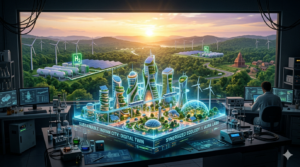
A Future Built on Bio-Bricks and AI
The transformation extends to the very materials of the future. With the building sector accounting for 37% of global CO2 emissions, Indian scientists are testing “regenerative” construction materials, including bio-bricks made from rice husks and algae-based foams.
Supporting this physical infrastructure is a high-tech “digital nervous system.” The report advocates for a national Water Cyber Infrastructure and the use of AI-driven “digital twins”—advanced simulations that can predict how the water cycle, energy needs, and public health will interact in a warming world.
A Model for the World
While India currently ranks 138th in emissions per capita, its sheer scale means its success is vital for the entire planet. By unifying research across the Indian Institutes of Technology (IITs), the Indian Institute of Science, and TERI, the ICEF report moves away from “isolated solutions” toward an integrated system that connects science directly to government policy and industry.
“Now is India’s moment to show the world how to build a prosperous, low-carbon economy at scale,” the report asserts. By leveraging breakthroughs in everything from green hydrogen to satellite-monitored carbon sinks, India aims to secure a safer, more equitable future for every community on Earth.
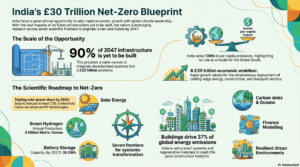
The report outlines seven key research frontiers at the intersection of scientific progress and real-world implementation, which include:
● Climate Transition Pathways: As India’s energy sector shifts away from fossil fuels, new modelling approaches can uncover potential economic and social disruptions to secure a just transition for all communities.
● Key Energy Technologies: Advances in solar voltaics, battery storage, green hydrogen, carbon capture and energy systems modelling are poised to accelerate the decarbonization of India’s energy sector.
● Modelling for Climate Finance: An integrated modelling framework can eliminate blindspots and capture interconnections across India’s economy, scoping supply, demand and risk at scale to unlock investment in a net-zero future.
● Land-Based Carbon Sequestration: India’s forests and fields can absorb the equivalent of half-a-billion tonnes of CO2, but a nationwide effort to expand monitoring, data analysis and coordinated research – especially in biogeochemistry and the carbon cycle – could increase that potential by 400%.
● Water and Ocean Sciences: A multidisciplinary initiative to unify water cycle research – from monsoon prediction to groundwater monitoring – under a national Water Cyber Infrastructure can improve health and safety outcomes across every community in India.
● Built Environment: Ninety per cent of the infrastructure India will need to reach its near-term economic goals does not exist yet, offering an extraordinary window to effectively design and build a net-zero nation.
● Resilient Cities: As India’s urban population grows by 25 million every year, emerging technology creates an opportunity to engineer low-carbon, adaptable cities that serve as models for liveable development in a warming world.
WOW,Very wonderful