Glaciers in many regions will not survive the 21st century if they keep melting at the current rate, potentially jeopardising hundreds of millions of people living downstream, Glaciers UN Report on climate experts said on the first World Day for Glaciers.
Five of the past six years have witnessed the most rapid glacier retreat on record. 2022- 2024 witnessed the largest three-year loss of glacier mass on record. In many regions, glaciers’ so-called “eternal ice” may not survive the 21st century. This is according to reports from the World Meteorological Organization (WMO) and the World Glacier Monitoring Service (WGMS).
More than 275,000 glaciers worldwide cover approximately 700,000 km2. Together with ice sheets, glaciers store about 70% of the global freshwater resources. High mountain regions are the world’s water towers. Depletion of glaciers therefore threatens supplies to hundreds of millions of people who live downstream and depend on the release of water stored over past winters during the hottest and driest parts of the year. In the short-term, glacier melt increases natural hazards like floods.
The United Nations General Assembly proclaimed 2025 as the International Year of Glaciers’ Preservation and established 21 March as the annual World Day for Glaciers. It seeks to increase awareness of the vital role that glaciers, snow, and ice play in the climate system and hydrological cycle, and their importance to local, national, and global economies. UNESCO and WMO are spearheading activities and coordinating international efforts supported by over 200 contributing organizations and 35 countries.
Glacier preservation is an environmental and economic necessity
“WMO’s State of the Global Climate 2024 report confirmed that from 2022-2024, we saw the largest three-year loss of glaciers on record. Seven of the ten most negative mass balance years have occurred since 2016,” said WMO Secretary-General Celeste Saulo.
“Preservation of glaciers is not just an environmental, economic and societal necessity. It’s a matter of survival,” she said.
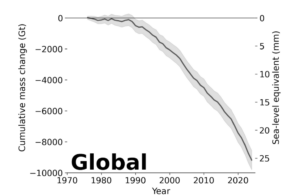
The World Glacier Monitoring Service has compiled data from around the world. Based on these observations, it estimates that glaciers—excluding the continental ice sheets in Greenland and Antarctica—have lost over 9,000 billion tons of ice since 1975.
“This is equal to an ice block the size of Germany and 25 meters thick,” says Prof. Michael Zemp, Director of the WGMS.
The 2024 hydrological year marked the third year in a row in which all 19 glacier regions experienced a net mass loss. Glacier mass loss was 450 billion tons in the 2024 hydrological year – the fourth most negative year on record. While the mass loss was relatively moderate in regions like the Canadian Arctic or the Greenland periphery, the glaciers in Scandinavia, Svalbard, and North Asia experienced their largest annual mass loss on record.
Glacier melt contributes to sea-level rise
The new findings complement a recent community effort published in the journal Nature in early 2025 and coordinated by the WGMS, which is hosted at the University of Zurich in Switzerland.
This study – the so-called Glacier Mass Balance Intercomparison Exercise (GlaMBIE) – found that between 2000 and 2023, glaciers lost 5% of their remaining ice. Regionally, the loss ranges from 2% in the Antarctic and Subantarctic Islands to almost 40% in Central Europe.
At present melt rates, many glaciers in Western Canada and the USA, Scandinavia, Central Europe, the Caucasus, New Zealand, and the Tropics will not survive the 21st century.
From 2000 to 2023, the global glacier mass loss totals 6,542 billion tons – or 273 billion tons of ice lost per year, according to the study. This amounts to what the entire global population currently consumes in 30 years, assuming three liters per person per day.
During this period, glacier melt contributed 18 mm to global sea-level rise.
lass=”yoast-text-mark” />>”This might not sound much, but it has a big impact: every millimeter sea-level rise exposes an additional 200,000 to 300,000 people to annual flooding,” said Zemp.
Glaciers are currently the second-largest contributor to global sea-level rise, after the warming of the ocean.
Glacier of the Year 2025
On the first World Day for Glaciers, the WGMS presented the first “Glacier of the Year”.
With this, the goal is to highlight the beauty of glaciers around the world. It also aims to honor glaciologists who have observed them for decades as part of a global monitoring effort. In 2025, South Cascade Glacier was selected as Glacier of the Year.
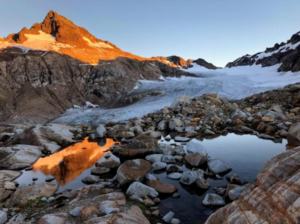
The South Cascade Glacier is in the Cascade Range in Washington, United States.
Scientists have continuously monitored it since 1952. It offers one of the longest uninterrupted records of glaciological mass balance in the Western Hemisphere.
“South Cascade Glacier exemplifies both the beauty of glaciers and the long-term commitment of dedicated scientists and volunteers who have collected direct field data to quantify glacier mass change for more than six decades,” says Caitlyn Florentine, Co-Investigator of the glacier from the U.S. Geological Survey.