By Shakoor Rather
The Hindu Kush Himalaya (HKH) region recorded its third consecutive below-normal Himalayan Snow year in 2025, with snow persistence—the duration snow remains on the ground after falling—dropping to a 23-year low of -23.6%. This alarming trend threatens the water security of nearly two billion people across 12 major river basins originating in the HKH.
ICIMOD Calls for Urgent Regional Action
Launching the 2025 Himalayan Snow Update Report, Pema Gyamtsho, Director General of the International Centre for Integrated Mountain Development (ICIMOD), stressed the need for immediate policy shifts and regional collaboration.
“Carbon emissions have already locked in an irreversible course of recurrent snow anomalies in the HKH. To tackle this regional snow crisis and the challenges it creates for long-term food, water and energy resilience, we urgently need to embrace a paradigm shift toward science-based, forward-looking policies and foster renewed regional cooperation for transboundary water management and emissions mitigation,” said Gyamtsho.
Impact on River Runoffs and Downstream Communities
Seasonal snowmelt contributes roughly 25% of annual runoff in HKH rivers, with a higher dependence observed in the western basins. Persistent deficits in snowmelt are expected to intensify early-summer water stress for downstream populations, who are already grappling with intensifying heatwaves.
Sher Muhammad, Remote Sensing Specialist at ICIMOD and lead expert of the 2025 Himalayan Snow Report, emphasized:
“We are observing such deficit situations occurring in continuous succession. This is an alarming trend. While our findings give broad picture across the region, each must act based on the specific conditions of their river basins, particularly where seasonal snow melt is the major water source.”
Eastern and Western Basins Both at Risk
Despite slightly improved conditions in some western basins compared to 2024, the report cautions that the overall situation remains critical. Seasonal snowmelt remains essential for water availability in the west, and any reduction exacerbates existing stress. In contrast, the eastern basins — which had near-normal conditions last year — have seen steep drops in snow persistence, some up to 50% below normal in 2025.
“Although seasonal snow contributes less to total meltwater here,” Muhammad explained, “around 15% drop in persistence of seasonal snow could still impact downstream communities, especially in the mountains and Tibetan Plateau, where annual snow conditions are generally erratic.”
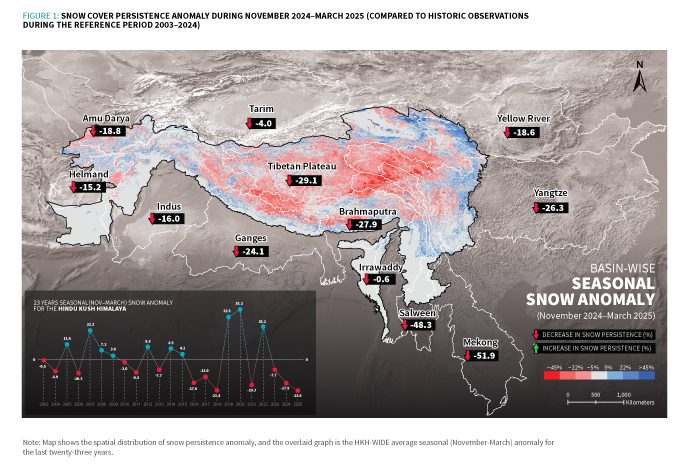
Sharp Declines in Key River Basins
The most severe drops in snow persistence were recorded in:
-
Mekong Basin: -51.9%
-
Salween Basin: -48.3%
-
Tibetan Plateau: -29.1%
-
Brahmaputra Basin: -27.9%
-
Yangtze Basin: -26.3%
-
Ganges Basin: -24.1%
These declines come as part of a 23-year monitoring effort (2003–2025), which shows a worrying pattern of recurrent deficits and growing year-on-year variability, especially over the last five years.
Basin-Level Observations Highlight Severity
-
Yellow River: From a peak of +98.2% in 2008 to a low of -54.1% in 2023, 2025 records a -18.6% anomaly. Continued deficits affect agriculture, hydropower, and water supply.
-
Yangtze River: Sixth-lowest snow persistence in 23 years at -26.3% threatens the Three Gorges Dam’s efficiency.
-
Mekong River: A dramatic fall from +80.3% in 2019 to -51.9% in 2025 endangers agriculture and hydropower.
-
Salween River: Snow persistence plummeted from +41.9% in 2020 to -48.3% in 2025.
-
Brahmaputra River: Dropped from +27.7% in 2019 to -27.9% in 2025, increasing drought risks.
-
Tibetan Plateau: From +92.4% in 2022 to -29.1% in 2025, showing extreme climate sensitivity.
-
Tarim Basin: Six consecutive years of deficits, including -4% in 2025, pose long-term water security threats.
-
Ganges River: Hit a record low of -24.1% in 2025, down from +30.2% in 2015.
-
Indus River: From +19.5% in 2020 to -16% in 2025, endangering supply for nearly 300 million people.
-
Helmand Basin: Recorded -15.2% in 2025, continuing Afghanistan’s water challenges.
-
Amu Darya Basin: Fourth lowest in 23 years at -18.8% in 2025, with potential downstream impacts.
 Call for Basin-Level Action and Adaptive Strategies
The report concludes with a call for basin-specific, adaptive water resource management strategies to counter the growing threat of snow deficits. It highlights the importance of:
-
Investing in seasonal water storage infrastructure
-
Improving meltwater use efficiency
-
Developing drought preparedness and response plans
-
Integrating snow anomaly data into national water policies
-
Disseminating data for evidence-based, coordinated actions
The 2025 Snow Update underscores the urgent need for coordinated regional response and resilient infrastructure to safeguard food, energy, and water security in the face of accelerating climate-induced changes in the HKH region.