By Dr. Raju Attada, Northwest India — already known for scorching summers — is heading toward unprecedented levels of human thermal discomfort due to climate change, a recent study led by researchers from the Indian Institute of Science Education and Research (IISER) Mohali has revealed.
The research, conducted by Professor Raju Attada’s group from the IISER Mohali, highlights how rising temperatures and humidity are combining to create dangerous thermal stress conditions that could reach deadly levels by the end of this century.
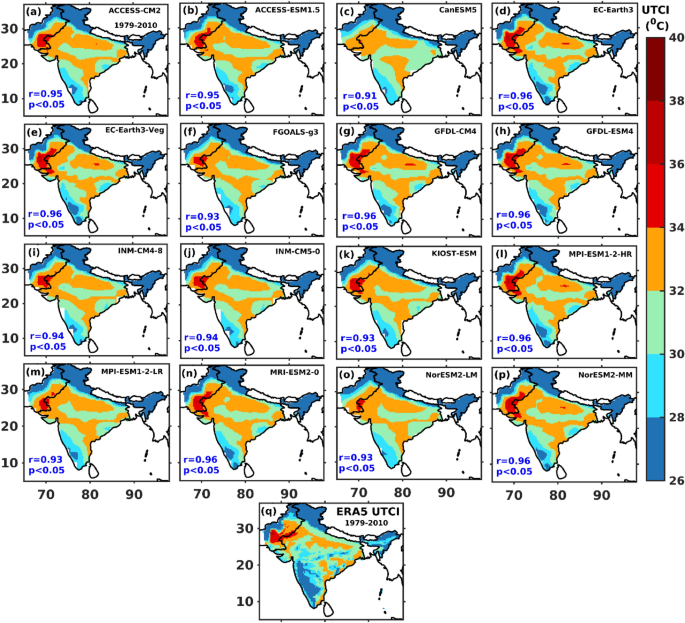
Using state-of-the-art global climate models from the CMIP6 framework, the study evaluated the past, present, and future patterns of thermal stress using the Universal Thermal Climate Index (UTCI). The results show a worrying increase in the frequency and intensity of extreme heat stress events in the region.
“Northwest India, which includes Punjab, Haryana, Rajasthan, and Delhi, is not just hot — it’s becoming dangerously hot,” says Dr. Raju Attada, the author of the study.
Climate Models Predict Soaring Temperatures and Humidity Will Threaten Health and Livelihoods
The models suggest that under the worst-case emission scenario (SSP5-8.5), the region could see UTCI values crossing deadly thresholds ( above 38°C) far more frequently by the end of this century.
Their analysis, published in Nature Scientific Reports, examines the climate projections estimated from CMIP6 models. Dr. Attada noted that the consistency of the trend across all scenarios indices the growing threat in over the next 75 years

The number of summer days with strong thermal stress (UTCI above 32°C) is rising by 2.8 days per decade in observations and 3.9 days per decade in model simulations. Future projections paint a worrying picture. Under the highest emissions scenario (SSP5-8.5), NWI may face up to a 5°C rise in thermal stress by the end of the century, with a two to threefold increase in very strong heat stress days (UTCI above 38°C).
Key findings show that NWI, including New Delhi, consistently experiences stronger and more frequent thermal stress compared to the rest of India. Both observational data (ERA5) and model simulations confirm a significant upward trend in thermal stress, with New Delhi recording higher increases than other major cities.
Under the high-emission scenario (SSP5-8.5), northwest India could face life-threatening heat conditions with temperatures rising by 0.56°C per decade, significantly worsening thermal stress and posing severe risks to health and livelihoods.
Between 1979 and 2010, thermal discomfort in NWI was already higher than the national average. But the number of “very strong thermal stress” days is projected to increase more than sixfold by 2100. Major Indian cities like Delhi, Kolkata, and Mumbai are also experiencing rising trends, with Delhi likely to suffer the most.
This is not just about rising temperatures
It’s the dangerous combination of heat and humidity that increases vulnerability. In such conditions, the human body struggles to cool itself through sweating, increasing the risk of dehydration and heat-related illnesses,” Dr. Krishna Kumar Shukla, the lead author of the study, explained.
The study also warns that the traditional heatwave season in North India, typically from April to June, is now starting earlier and lasting longer due to climate change. Extreme heat, especially when combined with moisture, can even trigger evening storms, as currently observed in Chandigarh, Mohali, and parts of Punjab.
Authors also suggest that North India usually experiences heat waves between April and June. But due to the effects of climate change or global warming, such extreme weather is now starting earlier and lasting longer. The extreme heat can sometimes trigger storms, if there is enough moisture supply, in the evening times lead to gusty winds, etc, which is currently being experienced in Chandigarh and Mohali, and some parts of Punjab.
Urgent Call for Action: Experts Recommend AI-Based Forecasting and Green Infrastructure to Combat Thermal Stress
The study also emphasizes the serious implications for health, agriculture, labor productivity, and the economy. Outdoor workers, the elderly, and the urban poor will be among the worst hit. The research also suggests that extreme heat stress potentially affects the performance of outdoor workers in the region due to physiological reactions.
As global temperatures continue to rise, cities in northwest India stand at the forefront of a growing climate crisis. Without immediate action, the region faces an unprecedented rise in heat-related deaths, declining agricultural output, and economic losses.
The authors call for urgent climate action and region-specific early warning systems to mitigate risks. They stress the need for robust planning, including better urban design, green infrastructure, and investment in thermal-stress forecasting using AI and machine learning.
The study concludes that this intensifying heat will pose serious risks to human health and productivity. It calls for urgent investments in early warning systems and localized prediction tools. Future studies should incorporate high-resolution modeling and AI/ML-based forecasting to better capture local climate extremes.
Dr. Raju Attada is an Assistant Professor at IISER Mohali. He holds a Ph.D. in Atmospheric Sciences from IITM Pune and completed postdoctoral research at KAUST, Saudi Arabia. His research focuses on monsoon dynamics, extreme weather events, and high-resolution climate modeling. Dr. Attada is an active member of several professional organizations, including the Indian Meteorological Society, American Geophysical Union, European Geosciences Union, Ocean Society of India, South Asian Meteorological Association, and the Japan Geoscience Union.