Scientists have developed a quantum computer that uses light to process data, paving the way for such machines that can operate in a networked environment at room temperature.
Canadian quantum computing company, Xanadu, said it has successfully build a universal photonic quantum computer consisting of four modular and independent server racks that are photonically interconnected and networked together.
This 12 qubit machine, known as Aurora, consists of 35 photonic chips and a combined 13 kilometre of fiber optics all operating at room temperature.
With this breakthrough, Aurora could in principle be scaled up to thousands of server racks and millions of qubits today, realising the ultimate goal of a quantum data center, the researchers said.
This result is published in the peer-reviewed journal Nature and marks a pivotal milestone towards realizing utility scale quantum computing, they said.
“The two big challenges remaining for the industry are the improved performance of the quantum computer (error correction and fault tolerance) and scalability (networking). Xanadu has now solved scalability,” Christian Weedbrook, the founder and CEO of Xanadu, said in a statement.
“Photonics really is the best and most natural way to both compute and network. We now could, in principle, scale up to thousands of server racks and millions of qubits, but first we will focus on performance in reducing loss and being fault tolerant,” Weedbrook said.
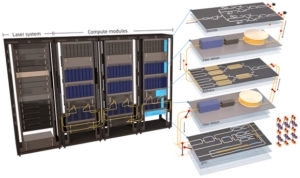
Xanadu’s architecture and the use of robust qubit states show that key quantum computational processes such as quantum gate operations, real-time error correction, and decoding are possible within the stringent limitations set by quantum clock rates and classical hardware control.
A realistic path to scaling up by orders of magnitude is provided, led by straightforward networking of an indefinite number of modules, which are necessary for large-scale implementations.
This stresses the importance of Aurora, as the three pillars that make up its metaphorical pedestal take the spotlight: scalability, modularity, and networkability.
The use of commercially available chips made through mature fabrication techniques, and significantly lower cooling requirements makes Aurora an attractive choice for the future of quantum computing.
Having accomplished a pivotal milestone on Xanadu’s hardware roadmap, the Xanadu team sets its eyes on tackling the next major hurdle towards fault-tolerant quantum computing: optical loss.