
By Durba Bhattacharjee
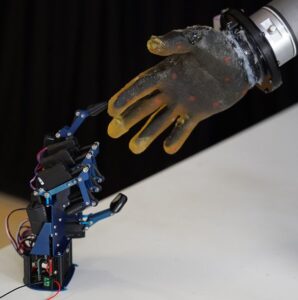
Imagine a robotic hand that not only moves like yours, but feels, responds, and even learns from touch like you do. That possibility just came a step closer, thanks to groundbreaking work by scientists from the University of Cambridge and University College London (UCL). FThey’ve developed a low-cost, flexible, and highly sensitive electronic skin that functions much like a glove over robotic hands. This synthetic skin brings machines one step closer to the nuanced world of human touch.
A Skin That Thinks and Feels
What sets this innovation apart is its simplicity. Unlike traditional robotic touch systems, where different sensors handle heat, pressure, or texture independently, this new skin is one unified material. Every inch of it can detect and process tactile information, just like human skin.
Embedded with over 860,000 microscopic signal pathways, the skin can sense finger taps, heat, cold, punctures, and even multiple contact points simultaneously.
“We wanted to develop a solution that can detect multiple types of touch at once, but in a single material,” said lead author Dr. David Hardman from Cambridge’s Department of Engineering.
From Gelatin to Genius
Made from a gelatin-based hydrogel that’s both stretchy and conductive, the skin was cast into the shape of a human hand. From just 32 electrodes positioned at the wrist, researchers collected over 1.7 million data points across the entire hand.
Tests included everything from gentle finger presses to slicing with a scalpel. Machine learning models then taught the robotic skin how to interpret the data, turning physical contact into meaningful, real-time feedback.
“It’s not quite human-level sensitivity yet, but it’s closer than anything we’ve seen,” noted co-author Dr. Thomas George Thuruthel from UCL.
Why It Matters
This electronic skin opens the door to countless applications—from humanoid robots and prosthetics to more rugged industrial settings like automotive assembly or disaster recovery. Because it’s cost-effective, durable, and easy to fabricate, it has potential for widespread adoption.
Unlike conventional systems that suffer from signal interference or fragility, this single-material skin is robust and designed for real-world use.
What’s Next?
The research team plans to enhance the material’s durability and expand its application to more dynamic tasks. As the line between synthetic and biological sensing continues to blur, this innovation is a powerful reminder: machines may never truly feel like us—but they can now feel with us.
journal: Science Robotics